Our work
Projects we’re
proud of
A selection of transmission and distribution projects delivered across Queensland and the Northern Territory — from mine site reticulation to solar farm grid connections.


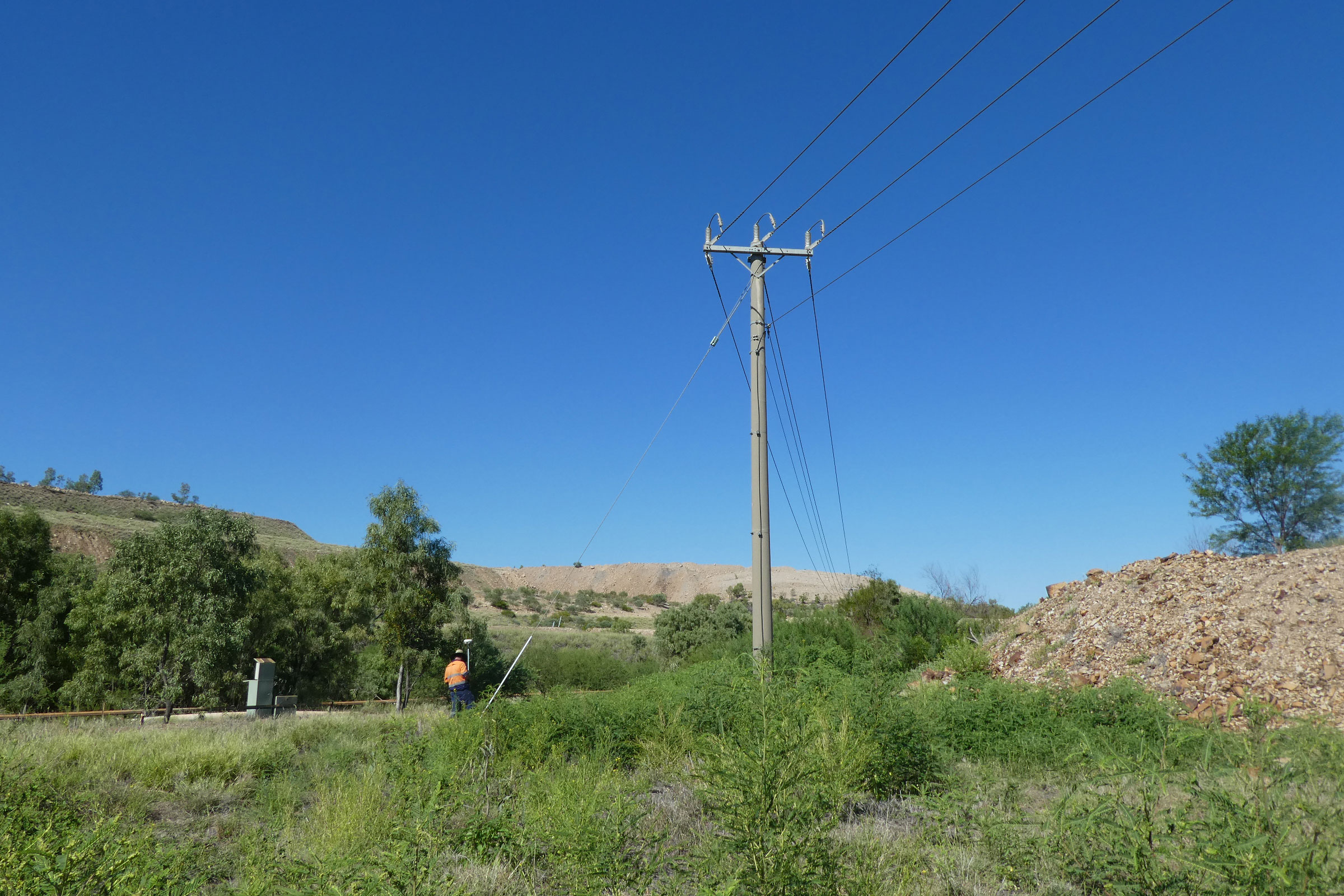
A selection of transmission and distribution projects delivered across Queensland and the Northern Territory — from mine site reticulation to solar farm grid connections.
Replacement of 18km of steel tower line supplying the main mine and township at Gove. A new line on steel poles was constructed adjacent to the existing line before the old line was dismantled. Wedcon surveyed existing infrastructure, selected the optimal alignment and designed the new line in PLS-CADD — including modelling of existing lines remaining in service. Design challenges included a coastal location in a cyclonic region requiring high wind loading and resistance to pollution from mining activities.
Design of a 6.5km double-circuit 33kV transmission line near Oakey, Southwest Queensland, connecting an 80MW solar farm to the electricity grid. Constructed on concrete poles with SELENIUM conductor and OPGW earthwire. Wedcon’s scope included line route survey, soil resistivity testing, PLS-CADD layout design and structure drawings. The line was designed to Ergon Energy standards for future asset transfer. Additional scope included a Low Frequency Induction study for two parallel steel high-pressure gas transmission pipelines.
Survey and design of 14km of 66kV incoming line plus 2km of 11kV lines for on-site reticulation at a new coal mine project in Central Queensland. Full line design from incoming supply through to mine site distribution network.
Survey and design of 6.2km of 66kV line for a coal mine expansion in Central Queensland — 4.4km on concrete poles and 1.8km on wood poles. A key challenge was the client’s requirement to reuse pre-owned concrete poles recovered from various line retractions over 30 years. Many poles had limited documentation, requiring careful physical measurement and collaboration with the original manufacturer to determine pole strength and moment capacities, then designing compatible hardware for each pole type.